
Announcements

  • Não Desviar o Olhar (2026) de Júlio Alves

    CFP. Vol. 2 No. 1: Criticism at Its Critical Moment: Cinema and Media Facing the Challenges Posed by the Digital Revolution


    2026-10-02

    Deadline: January 30

    This issue seeks to awaken the etymological affinity, derived from the Greek, between Kritikos and Krísis. The critic is someone who, by virtue of their own po(i)etics, analyzes the work while safeguarding a just distance—one that makes possible both the process of decoding and that of assessment. The critic immerses themselves in the time of the work while simultaneously delineating safety distances in their relationship with the object of study, namely by integrating it into a tradition or set of movements that precede it. The critic is, by definition, both product and producer of this distance, something that is the sine qua non condition of their activity, since all criticism is also a form of mediation. Faced with various pressures—technical, social, political, and economic—we ask ourselves about the paths of criticism across the different domains of communication and the arts: to what extent can a certain critical exercise represent an escape from the dissolution of the spectator into the condition (or role) of consumer (without memory), from the reduction of the work of art to content or product (without identity)? In what way will the thinking or rethinking of criticism as a journalistic and literary genre—at a time when it is not only defined as crisis but is effectively in crisis—depend, or not, on the affirmation of a lost "art of loving" (Jean Douchet) in a society that is perhaps excessively Cartesian, cerebral, or algorithmic (even as it becomes ever more amnesiac and uncritical), in which love itself is reduced to highly instrumental codes and keywords? Have we reached the "decisive moment" in which it has become imperative and just to reconvene and renew a certain way of doing criticism as a means of recovering a lost distance with time and things? The die is cast for a return to the territory of criticism.
    We invite submissions in the areas of media art, film studies, philosophy of cinema, philosophy of technology, semiotics, critical theory, media theory, and visual studies. There are no processing or publication costs for authors.


    Call for papers: until January 30, 2027
    Notification of decisions to authors: April
    Second round of review and editing: May
    Publication: July 2027


    Issue editors: Júlio Alves and Luís Mendonça.


    Please consult registration and submission information at: https://revistas.ulusofona.pt/index.php/caleidoscopio/about/submissions.

    Read more about CFP. Vol. 2 No. 1: Criticism at Its Critical Moment: Cinema and Media Facing the Challenges Posed by the Digital Revolution
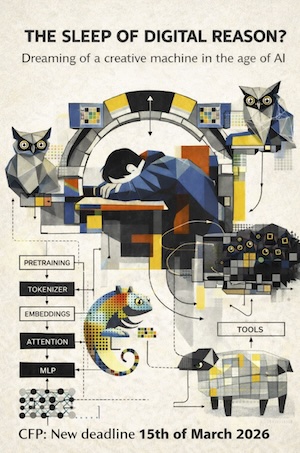
  • CFP: Vol. 1 No. 2: The sleep of digital reason? Dreaming of a creative machine in the age of AI

    2025-09-21

    The_Sleep_of_Digital_Reason_A2_150x3001.jpg

    This special issue will examine these medial shadows of reality and rational monsters of automated writing—whether genuine entities or mere accumulations of masks—exploring their genealogies, infrastructures, and

    transformative effects on literary and media culture and inside (generative) media arts and philosophy. We invite scholarship that explores fundamental questions about authorship, —including script and screenwriting, creativity, and literary and other forms of artistic production processes through rigorous theoretical frameworks, empirical analysis, and/or critical reflection on the implications of AI for literary and media culture.

    We invite submissions that articulate approaches within media theory, visual studies, philosophy of technology, cybernetics, or contemporary artistic practices.

    Call for papers: until 15 March 2026

    Decision communicated to authors: end of April

    2nd round review and editing: May 

    Publication: July 2026


    Issue editors: José Gomes Pinto (Lusófona University) and Alexander Gerner (Lusófona University)


    Please find full call text below and registration and submission information at https://revistas.ulusofona.pt/index.php/caleidoscopio/about/submissions.

    Read more about CFP: Vol. 1 No. 2: The sleep of digital reason? Dreaming of a creative machine in the age of AI
  • CFP: Vol. 1 No. 1: Becoming Media: Operativity and Medialogical Structures

    2025-02-14

    Call for papers open until June 2, 2025.

    Between Wolfgang Ernst’s (2016) notion of active operative media and André Leroi-Gourhan’s (1964) operational chains composed of gestures and tools, we find the figure of operativity, which emphasizes the processes of co-constitution and performativity through which operations—as material ontogenetic forces—produce both the real and the symbolic, instantiating limits, interfaces, and infrastructures that constitute articulations of the real (Siegert, 2015).

    Originally applied in the contexts of the military-security complex and logistics (Parikka, 2023), the logic of operativity has since expanded into the domains of political control (Massumi, 2015), cybernetics and archives, world visualization and the production of the visual, technological media, and the algorithmic logic of computerized culture (Friedrich; Hoel, 2021).

    Harun Farocki (2004), in an analysis extendable beyond the military uses of images that motivate it, proposes the notion of operative/ghost images—images that do not represent an object but are part of an operation. Therein lies a profane space situated outside, in a non-localized medialogical structure and a horizon of estrangement.

    We invite submissions that articulate approaches within media theory, visual studies, philosophy of technology, cybernetics, or contemporary artistic practices.


    Call for papers: until 2 June 2025

    Decision communicated to authors: end of June

    2nd round review and editing end of July 

    Publication: September 2025


    Please find registration and submission information at https://revistas.ulusofona.pt/index.php/caleidoscopio/about/submissions.

    Read more about CFP: Vol. 1 No. 1: Becoming Media: Operativity and Medialogical Structures