[Open] CALL FOR PAPERS Vol. 13 No. 1 (2028) Electricity and Its Impact on Visual and Aural Culture from Modernity to Contemporary Times
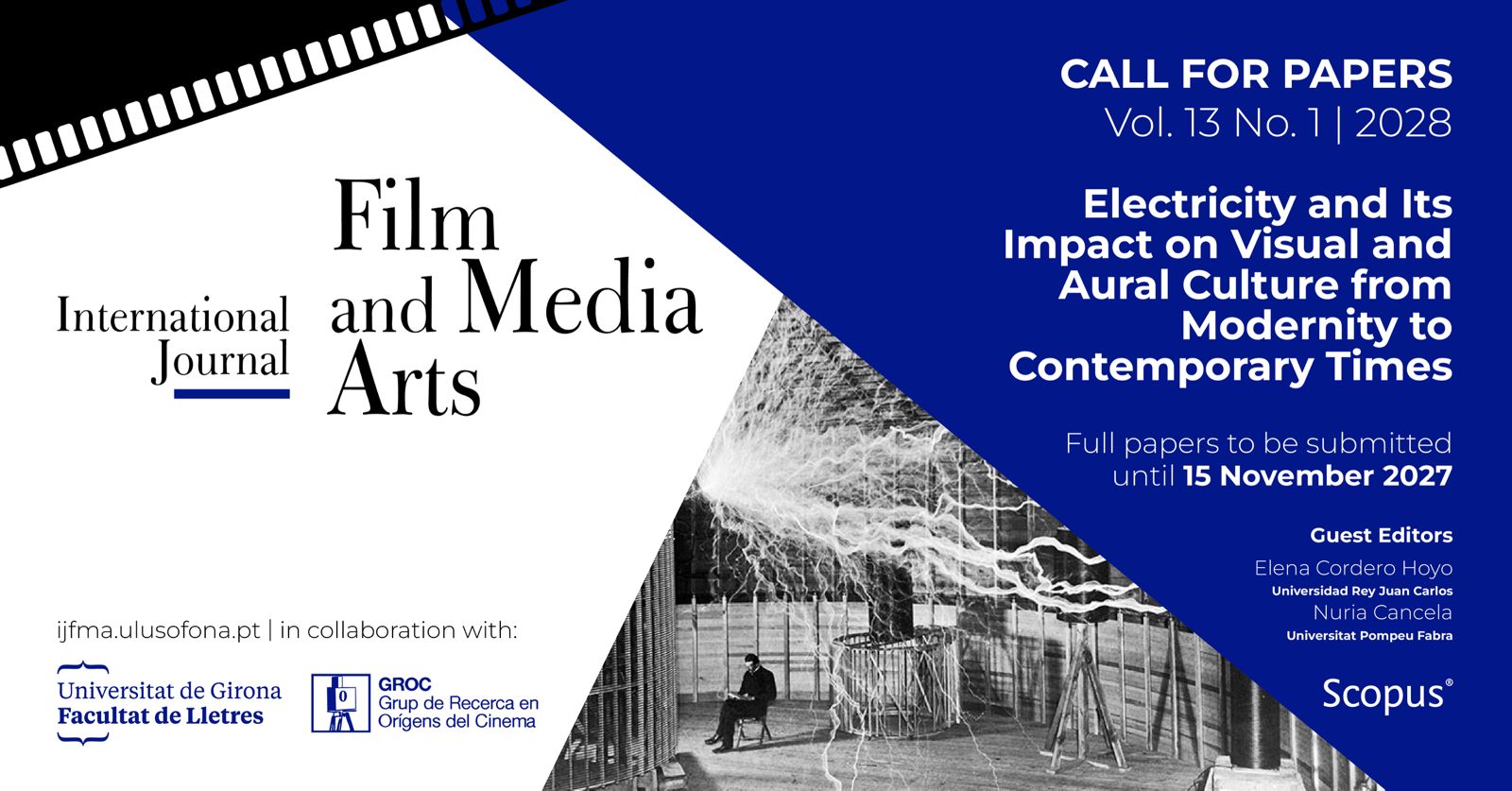
This issue of the International Journal of Film and Media Arts (IJFMA), guest-edited by Elena Cordero Hoyo and Nuria Cancela, invites researchers to submit original papers that critically engage with, but are not limited to, the following topics:
- The introduction of electricity into everyday life in both domestic and public spheres (lighting, communication systems, transportation, etc.) focusing on its impact on perception and representation;
- Electrical imaginaries in visual and performing arts, including photography, cinema, illustration, and live spectacles;
- The impact of electricity on the formation of film genres such as slapstick, the western, noir or melodrama;
- The impact and presence of electricity in world’s fairs, such as Barcelona 1888, Paris 1889 and 1900, Chicago 1893, Saint Louis 1904, or San Francisco 1915, which contributed to legitimising electricity as a symbol of modernity;
- The application of electricity in medicine and its influence on perceptions and the depiction of corporeality and mortality;
- Differences related to gender, age, race, ethnicity, or social class in representations of the impact of electricity—for example, the arrival of household appliances and their association with feminine imaginaries;
- The use of electricity in film production and exhibition (shooting practices, projection systems, the emergence of the star system, etc.);
- The influence of electricity on sound recording and reproduction, and its application to cinema;
- Esotericism and electricity: superstitions, animism, and their impact on the visual culture of the period;
- Electricity in contemporary cinema and photography from a critical and/or marginal perspective (relations to dystopian, apocalyptic, or science fiction currents);
- The impact of electricity and Artificial Intelligence on cinema, analysed from ecocritical, postcolonial, posthumanist perspectives, among others.
This monograph aims to bring together contributions that reflect on the uses of electricity in visual and aural culture, from the emergence of modernity at the end of the nineteenth century to its expansion in the digital era and the current revolution driven by generative AI tools in contemporary times. The proposal is framed within the research project The Impact of Electricity on Cinema and Photography at the Turn of the Century: From Transformations of Vision to the Animism of Objects (1885–1919) (ELECTROCINE) (PID2024- 161149NB-I00), based at the Universitat de Girona and funded by MICIU/AEI and FEDER (EU). It seeks to establish dialogues and audiovisual correspondences between past and present, shaped by an increasing dependence on electrical energy. The project proposes to examine how the advent of electricity transformed ways of perceiving the world and art—both visually and aurally—thereby altering the human relationship with objects and anticipating the digital culture of the twenty-first century.
The widespread dissemination of electricity in modern Europe gave rise to a genuine electrical civilisation, which assumed not only a functional but also a symbolic value. Electricity means, above all, modernity: technical, scientific, and social progress. The new engines that enabled industrial growth are children of electricity, as are the new communication instruments—the telephone, the telegraph—that shortened distances, and the new modern forms of entertainment that enlivened European cities during the night, now illuminated thanks to electric current.
Among the latter, cinema assumed a paradigmatic value: an extraordinary compendium of optics, mechanics, and electricity which, precisely because of its modern quintessence, provoked reactions ranging from utopian enthusiasm to dystopian pessimism. The same can be said of electricity, which unleashed ambiguous reactions in public opinion between those who exalted its power in an almost mystical manner—as attested by the numerous electrical fictions and utopias of the period—and those who emphasised its dangerousness and urged caution. In both cases, it is evident that the new society could not exist without this force, which, while contributing to defining modernity, also articulated its own distinct visual culture.
As a result of the new scientific discoveries—of which nineteenth-century mesmerism or “animal magnetism” is a symptomatic antecedent—the human body began to be conceived increasingly as a network of electrical impulses, in tune with research into visual perception and the physiology of movement which, from the late nineteenth century onward, proceeded from the premise of a universal energy in constant oscillation. This reconfiguration constitutes one of the foundational axes of modern visual culture: it is not only the represented object that changes, but the very regime of visibility and the conditions of looking. Cinema emerges as the privileged terrain where this transformation becomes visible and unfolds in all its power: by exponentially increasing the capacity for the circulation of images, it contributes decisively to the progressive process of dematerialisation of bodies described by Tom Gunning, which become shadows made of electricity, endowed with a new magnetic and seductive capacity. This condition is made explicit in films such as The Electric Hotel (1908) by Segundo de Chomón, where electricity not only animates everyday objects, giving them “soul,” but also stages the cinematic apparatus itself as an electrical machine capable of reconfiguring the relationship between body, object, and image.
The project proposes to investigate how the advent of electricity transformed the ways of perceiving the world and art—both through vision and hearing—thereby altering the human relationship with objects and anticipating the digital culture of the twenty-first century. Early cinema, indebted to photography and to the preceding spectacles of attractions, made possible new forms of creation, circulation, and reception of images (still and moving) and sounds, entirely conditioned by the expansion of electricity, especially in urban centres. The introduction of new objects into public and private spheres fostered the emergence of an expanding consumer society that modified everyday life and dominant and alternative cultural imaginaries. In this way, the present proposal for a monograph seeks not only to bring together research analysing the images and sounds that circulated transnationally during the turn-of-the-century period, but also to contextualise these new representations and forms of perception through the technological, social, and political connections that made them possible.
Contributions addressing the uses and representations of electricity in contemporary cinema from a critical perspective are also encouraged. Methodologically, priority will be given to studies presenting new case studies drawn from archives, museums, film libraries, and other institutions responsible for preserving and cataloguing materials (whether photographic, cinematic, or paper-based).
Keywords: electricity; Early cinema; photography; visual culture; modernity
References
Asselin, Olivier; Silvestra, Marinello & Andrea, Oberhuber (2011). L’ère electrique/The electric age. Otawa University Press.
Barel-Moisan, Claire & Gleizes, Delphine (2026). Merveilles électriques. Littérature, culture visuelle et vulgarisation (1740-1940). LISAA éditeur.
Carr, Nicholas G. (2009). El gran interruptor: el mundo en red, de Edison a Google. Deusto.
Castillo Martínez de Olcoz, Ignacio Javier (2006). El sentido de la luz. Ideas, mitos y evolución de las artes y los espectáculos de la luz hasta el cine [Doctoral Thesis]. Universitat de Barcelona.
Firstenberg, Arthur (2021). El arcoíris invisible. Ediciones Atalanta.
Gailli, Doron (2020). Seeing by Electrictiy: The Emergence of Television, 1878-1939. Duke University.
Gunning, Tom (1996). “Tracing the Individual Body: Photography, Detectives, and Early Cinema.” In Leo Charney & Vanessa R. Schwartz (Eds.). Cinema and the Invention of Modern Life, 15-45. University of California Press. https://doi.org/10.1525/9780520916425-003
Keating, Patrick (2010). Hollywood Lighting from the Silent Era to Film Noir. Columbia University Press.
Moreda, Eva (2021). Inventing the Recording. The Phonograph and National Culture in Spain 1877-1914. Oxford University Press.
Oakley, Catherine (2015). “Disruptive Energies”: Electrotherapy and Early Fiction Films in Europe and America, 1907-1911. Journal of Literary & Cultural Disability Studies, 9(3), 295- 321, https://doi.org/10.3828/jlcds.2015.24
Rabinovitz, Lauren (2012) Electric Dreamland: Amusement Parks, Movies, and American Modernity. Columbia University Press.
Turvey, Malcom (2008). The Filming of Modern Life. European Avant-Garde Film of the 1920s. MIT Press.
Guest Editors
Elena Cordero Hoyo (Universidad Rey Juan Carlos)
PhD in Comparative Studies from the School of Arts and Humanities of the University of Lisbon, with a doctoral thesis about women’s access to silent film industry in the Iberian context. She is an Assistant Professor of Audiovisual Communication at the University Rey Juan Carlos in Madrid. She is the co-editor of two collective volumes: Women in Iberian Film Culture: A Feminist Approach to Cinemas in Portugal and Spain (Intellect, 2020) and Ibéricas. Las mujeres y la construcción del espacio cultural peninsular (Comares, 2025). She has also published her research in high-impact journals and presented it at international conferences. Currently, she a member of two R+D funded projects by the Spanish Ministry of Science and Innovation: “The Impact of Electricity on Cinema and Photography at the Turn of the Century (1885-1919): From Transformations of Vision to the Animism of Objects” (PID2024-161149NB-I00) and “Visual Cultures around the 1929 Barcelona International Exposition: Image, City and Modernity” (PID2024-160703NB-I00). Furthermore, she is chief editor of the indexed journal of film history, Secuencias.
Orcid: https://orcid.org/0000-0003-3157-6275
Nuria Cancela (Universitat Pompeu Fabra)
PhD in Communication from Universitat Pompeu Fabra, with a doctoral thesis focused on the archetype of the femme fatale in the Spanish cinema during Francoism. She is an Associate Professor of Spanish cinema, gender and star studies at ESCAC (Film and Audiovisual School of Catalonia). She has published her research in high-impact journals and presented it at international conferences. Currently, she a member of two R+D funded projects by the Spanish Ministry of Science and Innovation: “The Impact of Electricity on Cinema and Photography at the Turn of the Century (1885-1919): From Transformations of Vision to the Animism of Objects” (PID2024-161149NB-I00) and “Affect Politics in Female Figuration: The Gestural Evolution of Actresses in Contemporary Spanish Cinema” (PID2025-171733NB-I00). Furthermore, she has a hybrid and creative profile related to the audiovisual creation and dissemination, and has professional experience in programming and archiving at the Mostra Internacional de Films de Dones de Barcelona.
Orcid: https://orcid.org/0000-0002-4737-3125
Submission Guidelines & Deadlines
The double-blind peer review process will only start after the Full Paper Submission Deadline has passed. Authors are strongly encouraged to check the Publication Schedule.
Schedule for Publication:
Full Paper Submission Deadline: 15 November 2027
Feedback on Full Papers: July 2028
Final Revisions Due: Set 2028
Publication Date: Nov 2028
Manuscript Preparation
Authors must prepare and submit two separate Word documents (.doc) with no identifying information (see below) via our online platform:
Please submit to: https://revistas.ulusofona.pt/index.php/ijfma/about/submissions
Full Paper Manuscript:
This document must contain the Title, Keywords, Full Article, and References APA Style (Videos/ Films should also be cited).
Anonymity is mandatory: The manuscript must not contain any reference to the authors, their name(s), or their institutional affiliation(s), directly or indirectly. Authors are responsible for ensuring all identifying markers are removed before submission.
Author Information & Bio:
A brief Biography of no more than 50-70 words.
This document must clearly state the Author Name(s), Email Address(es), and Institutional Affiliation(s). It should not be included in the full paper document.
Open Call Designation & Scope
IJFMA typically has multiple current open calls. To ensure your paper is reviewed by the correct guest editors and reviewers, authors must include a clear comment during the submission process indicating the specific open call (by Volume/Number and/or Title) they are responding to:
Submissions outside the scope of all current open calls will not be considered for peer review.
Submissions received after the deadline will not be considered.
Peer Review Process & Fees
All submissions must be made anonymously and will undergo a double-blind peer review process. Each paper will be evaluated by at least two independent reviewers.
No fees are requested for submission or processing.